
Sleep Position During Pregnancy: What the Science Says
May 25, 2026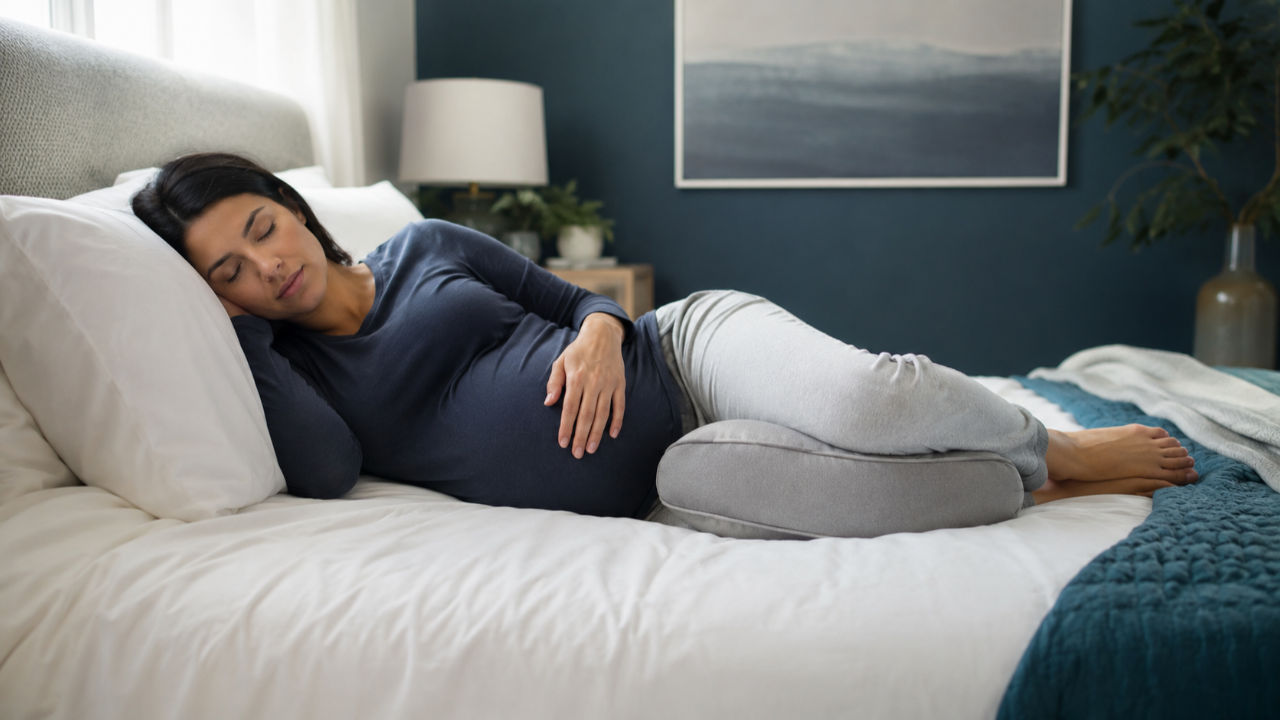
Key Findings
Supine going-to-sleep position after 28 weeks of gestation is independently associated with increased risk of late stillbirth, with a pooled individual participant data meta-analysis of five case-control studies finding that supine position approximately doubled the odds of stillbirth compared to left-side sleeping. (Warland et al., 2019)
A 2019 individual participant data meta-analysis confirmed that if every pregnant woman went to sleep on her side after 28 weeks, approximately 6% of late stillbirths could be prevented, with no significant difference in safety between left-side and right-side sleeping. (Warland et al., 2019)
Up to 56% of pregnant individuals develop low back pain during pregnancy, driven by increased lumbar lordosis, ligamentous laxity, and altered weight distribution, all of which are directly affected by sleep position and spinal support. (Bhimani & Bhimani, 2025)
Most pregnant people have heard some version of the rule: do not sleep on your back. It circulates in prenatal classes, pregnancy apps, and well-meaning conversations between friends. The problem is that the rule almost never comes with context. When does it apply? Why does it matter? How serious is the risk? And what about waking up on your back at 3 a.m.?
The answers are more specific and more actionable than the shorthand suggests. The research on sleep position during pregnancy has advanced significantly over the past decade, and what it reveals has direct consequences for how pregnant people sleep, what support they use, and how their care providers communicate risk.
Sleep disruption in pregnancy is nearly universal. Prevalence climbs from roughly 63% in the first trimester to over 80% in the second, with the third trimester carrying the heaviest burden of all (Sarvaran et al., 2023). Insomnia, restless legs, positional discomfort, and frequent waking converge at exactly the stage when sleep position matters most. That collision is not a coincidence. It is a solvable problem with the right information and the right physical support.
The vascular mechanism behind the back-sleeping guidance is straightforward. When a pregnant person lies flat on their back in the third trimester, the weight of the uterus presses directly onto the inferior vena cava, the large vein that returns blood to the heart from the lower body, and on the descending aorta. Think of a garden hose with a weight placed across it: flow does not stop entirely, but it is meaningfully reduced. This compression, known as aortocaval compression, decreases maternal cardiac output and reduces uteroplacental blood flow (Warland & Mitchell, 2015).
The risk from this mechanism is real and well-documented. A multicentre case-control study across seven New Zealand health regions found that supine going-to-sleep position was associated with a significantly elevated risk of late stillbirth compared to left-side sleeping, after adjusting for known confounders (McCowan et al., 2017). A 2019 individual participant data meta-analysis pooled findings from five studies across multiple countries and confirmed the association, concluding that supine going-to-sleep position approximately doubled the odds of stillbirth and that if all women in the third trimester settled to sleep on their side, approximately 6% of late stillbirths could potentially be prevented (Warland et al., 2019). That figure represents roughly 153,000 babies per year worldwide.
Two points of clarification matter here. First, the research focuses on going-to-sleep position, not position at every moment throughout the night. Waking up on your back during sleep is not the same risk exposure as deliberately settling to sleep supine. Second, the guidance applies most clearly after 28 weeks of gestation, when uterine size is sufficient to produce clinically significant compression. Neither of these points diminishes the importance of the guidance. They give it precision.
For years, the advice was specific: sleep on the left. The rationale was that the inferior vena cava runs along the right side of the spine, making a left-side position slightly more advantageous for blood return. The research has since refined this picture. The 2019 meta-analysis found no significant difference in safety between left-side and right-side sleeping (Warland et al., 2019). Both are considered safe. This matters practically, because insisting on the left side only makes compliance harder, and compliance is the whole point.
The vascular risk gets most of the attention, but the musculoskeletal picture is equally significant for daily quality of life. Pregnancy drives a progressive increase in lumbar lordosis, the inward curve of the lower spine, as the uterus shifts the body's center of gravity forward. Ligaments soften throughout pregnancy in preparation for delivery. The abdominal muscles lengthen and lose mechanical advantage. Together, these changes increase mechanical load on the lumbar spine and the sacroiliac joints in ways that are substantially worsened by poor sleep positioning (Bhimani & Bhimani, 2025).
Research published in 2025 reviewing pregnancy-related spinal biomechanics found that up to 56% of pregnant individuals develop low back pain, with lumbar lordosis, ligamentous laxity, and anterior pelvic tilt identified as primary drivers (Bhimani & Bhimani, 2025). Poor sleep position does not cause these changes, but it amplifies them across the six to nine hours a person spends in bed each night.
Side sleeping without support creates its own set of problems. When the top leg falls forward unsupported, it rotates the pelvis and pulls on the sacroiliac joint and the lumbar spine. A 2024 study using surface electromyography to measure muscle activation across different sleep positions found that a lateral position with a pillow placed between the knees produced significantly lower activation in the perineal and lower back muscles compared to unsupported side lying (Determining optimal sleep posture, 2024). The pillow between the knees is not a comfort preference. It is a functional intervention that keeps the pelvis level and allows the surrounding muscles to genuinely rest.
A lumbar support wedge addresses a separate but related problem: the gap between the waist and the mattress that develops in side lying. Without support in that space, the spine hangs unsupported and the muscles compensate with low-level activation that persists through the night. Filling that gap maintains neutral spinal alignment, meaning the natural position of the spine when the cervical, thoracic, and lumbar curves are in proper relationship to each other.
The practical goal is side lying, supported, with the pelvis level. A pillow placed between the knees and running down to the ankles maintains hip stacking and prevents pelvic rotation. A wedge or folded pillow placed under the abdomen provides belly support and reduces the downward pull on the uterine ligaments. For people who habitually start on their back, a semi-reclined position achieved by propping the torso at a 30 to 45 degree angle substantially reduces aortocaval compression and is considered a safe alternative for people who find flat side lying intolerable in late pregnancy.
For health and wellness professionals working with pregnant clients, and for individuals navigating these changes on their own, the evidence points in one direction: the position you go to sleep in after 28 weeks of gestation is a modifiable factor, and the spinal support surrounding that position affects both sleep quality and physical recovery across nine months and beyond. What that looks like in practice depends on whether you are applying this in a clinical context or to your own sleep. Both deserve a direct answer.
For Professionals
What This Means for Health and Wellness Professionals
The sleep position conversation in prenatal care tends to be brief. Clients are told to sleep on their left side and handed no further guidance about the mechanism, the trimester-specific nuance, or the practical tools that support compliance. For professionals working in health coaching, physical therapy, nursing, midwifery, or any adjacent field, this is a gap with real clinical relevance.
The research is clear that going-to-sleep position after 28 weeks carries independent risk for late stillbirth through the mechanism of aortocaval compression, and that this risk is modifiable (McCowan et al., 2017; Warland et al., 2019). When clients understand the mechanism rather than just the rule, compliance improves. The vascular garden-hose analogy is accessible and mechanically accurate. It gives clients a mental model that survives the 2 a.m. temptation to roll onto their back.
Equally important is correcting the left-only myth. Current evidence shows no significant difference in safety between left-side and right-side sleeping (Warland et al., 2019). Clients who have been forcing themselves onto one side only and finding it unsustainable can be told that either side is acceptable. That single clarification often improves both compliance and sleep quality simultaneously.
The musculoskeletal dimension offers equal opportunity for professional impact. Up to 56% of pregnant clients will develop low back pain (Bhimani & Bhimani, 2025), and a significant proportion of that load is carried during the hours they spend in bed. Assessing sleep position, pillow use, and surface support should be a standard component of prenatal intake for any professional working with this population. A pillow between the knees, adequate lumbar support, and education about pelvis-level alignment can reduce overnight musculoskeletal strain before it becomes a presenting complaint.
Electromyography research confirms that supported side lying measurably reduces muscle activation in the lower back and perineal region compared to unsupported lateral positioning (Determining optimal sleep posture, 2024). That is a clinically meaningful finding that belongs in client education conversations.
For professionals who want a focused curriculum covering sleep position, spinal alignment, and ergonomic support for pregnancy and other populations, the Sleep Posture and Ergonomics Certified Specialist (SPECS) program offers three lessons of targeted content at $499 one-time, carrying 0.2 continuing education units approved by NASM and AFAA, with a professional registry listing included with your certification.
For Individuals
How to Use This for Your Own Sleep
If you are pregnant and reading this after another rough night, here is what the research translates to in practical terms.
After 28 weeks, your going-to-sleep position matters more than what happens during the rest of the night. If you wake up on your back at 3 a.m., roll to your side and go back to sleep. What matters is how you settle down when you first close your eyes and what you do when you consciously reposition during the night.
Left or right side both work. Pick the one that is more comfortable. If you have been forcing yourself onto your left side only and it is making sleep harder, you can stop. Both sides are considered equally safe based on current evidence.
A pillow between your knees does a specific job: it keeps your pelvis level, which takes the pull off your sacroiliac joints and lower back. Place it so it runs from your knees down toward your ankles. If you have hip or lower back pain, this single change may shift things noticeably within a few nights.
If your belly feels like it is hanging and pulling at night, a pillow or wedge placed under it from the front addresses that directly. If you wake up stiff through the lower back, a small folded towel or thin pillow at your waist filling the gap between your hip and the mattress often helps more than any other single change. If you cannot tolerate flat side lying, propping your torso to a semi-reclined position is safer than flat-back sleeping and worth trying before assuming side lying is off the table.
For a complete step-by-step guide to sleep positioning, ergonomic support, and posture during pregnancy, The ERGO Protocol covers all of this across three video lessons at $199 one-time, with lifetime access to all future updates.
Citations
Bhimani, R., & Bhimani, M. (2025). Pregnancy-related spinal biomechanics: A review of low back pain and degenerative spine disease. PMC. https://pmc.ncbi.nlm.nih.gov/articles/PMC12383562/
Determining optimal sleep posture for pregnant women using surface electromyography and fuzzy logic analysis. (2024). Diabetes & Metabolic Syndrome: Clinical Research & Reviews, 18(1), Article 102940. https://doi.org/10.1016/j.dsx.2024.102940
McCowan, L. M. E., Thompson, J. M. D., Cronin, R. S., Li, M., Stacey, T., Stone, P. R., Lawton, B. A., Ekeroma, A. J., & Mitchell, E. A. (2017). Going to sleep in the supine position is a modifiable risk factor for late pregnancy stillbirth. PLOS ONE, 12(6), e0179396. https://doi.org/10.1371/journal.pone.0179396
Sarvaran, K., Abbasalizadeh, F., Alaei, M., & Fathnezhad-Kazemi, A. (2023). Prevalence of sleep disorders and the effect of sleep health education on sleep quality in pregnant women with sleep disorders. American Journal of Health Promotion, 38(1). https://doi.org/10.1177/15598276231178746
Warland, J., & Mitchell, E. A. (2015). Maternal sleep position: What do we know where do we go? BMC Pregnancy and Childbirth. https://www.ncbi.nlm.nih.gov/pmc/articles/PMC4402690/
Warland, J., Dorrian, J., Morrison, J. L., & O'Brien, L. M. (2019). Maternal sleep during pregnancy and poor fetal outcomes: A scoping review of the literature with meta-analysis. Sleep Medicine Reviews, 41, 197–219. https://doi.org/10.1016/j.smrv.2018.03.004
Sleep affects everything. If you found this article useful, you will find even more inside the SCI library, including practical tools for professionals and individuals navigating real sleep challenges.
Stay connected with news and updates!
The science of sleep keeps moving. So do we. Join the SCI newsletter for evidence-based insights, new research, and practical tools delivered directly to the people who need them most.
Your information is never shared. Unsubscribe anytime